By Nirooshitha Sethuram, Yogaratna
Graphics by Sheralee (Shambhavi) Hancherow
Fourteenth Day Continues
When Bhima unwillingly fulfilled his Vow, killing Vikarna, the Kaurava army scattered in all directions.
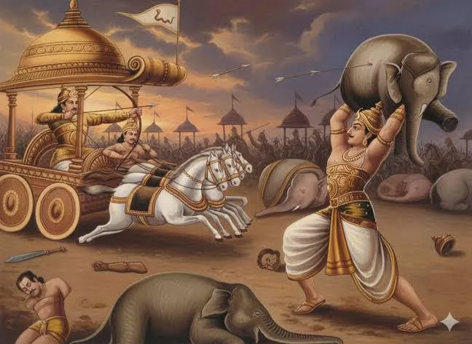
Fueled by rage, Karna charged at Bhima with all his might. Bhima engaged Karna in battle. When his supply of darts was exhausted, the enraged Bhima leapt from his chariot and hurled the broken remains of dead elephants, horses, and shattered chariots at Karna.
Karna cut them all to pieces with his arrows, then showered Bhima with a huge number of shafts.
Though he could have slain Bhima, Karna remembered his promise to his mother, Kunti. Touching Bhima’s shoulder with the tip of his bow, he said, “Do not fight with warriors like me, child. Go and seek the protection from Krishna and Arjuna.”
Wounded and enraged, Bhima hurled a dead elephant onto Karna’s chariot, then climbed aboard his own and rushed in search of Satyaki and Arjuna.
Evening drew near. After defeating the oncoming waves of enemy forces, Arjuna searched the entire battlefield for Jayadratha, but he was nowhere to be found. The sun began its slow, amber descent toward the horizon.
The Kaurava warriors fought not to defeat Arjuna, but simply to delay him. They knew that if the sun dipped below the horizon, Arjuna would voluntarily step into a funeral pyre, effectively ending the Pandavas’ greatest hope for victory.
On Shakuni’s advice, Duryodhana had hidden Jayadratha in a place beyond anyone’s reach, ensuring his safety. After a fruitless search, Arjuna began to lose hope. Duryodhana rejoiced, believing his plan had succeeded. As the sun neared the western horizon, the Kaurava forces smelt victory, and it echoed across the battlefield.
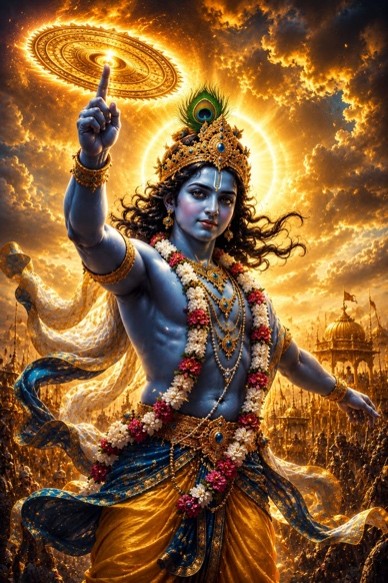
Seeing that time had physically run out with Arjuna still unable to find Jayadratha, Krishna took ultimate control of the situation. Though he had vowed not to weaponize his strength in the war, he invoked his supreme, cosmic weapon — the Sudarshana Chakra. The divine disc ascended into the heavens, glowing with the brilliance of a thousand suns.
Functioning on Krishna’s command to manipulate perception, it transformed itself into a dark disk. It positioned itself directly in front of the sun, casting an unnatural, sudden twilight, like an eclipse, over the entire expanse of Kurukshetra.
The golden sunlight vanished instantly, replaced by the eerie, deep purple and gray hues of late dusk. Nighttime birds began to chirp, and the battlefield fell into a momentary, stunned silence as nature itself seemed confused by the abrupt end of the day. Believing that nature had taken its course and the deadline had passed, the Kaurava army erupted into roars of triumph.
As the sun appeared to set, the Pandavas, unaware of Krishna’s divine intervention, believed that Arjuna’s attempt had failed. Panic-stricken and bewildered, they stood at Krishna’s feet, wailing in despair.
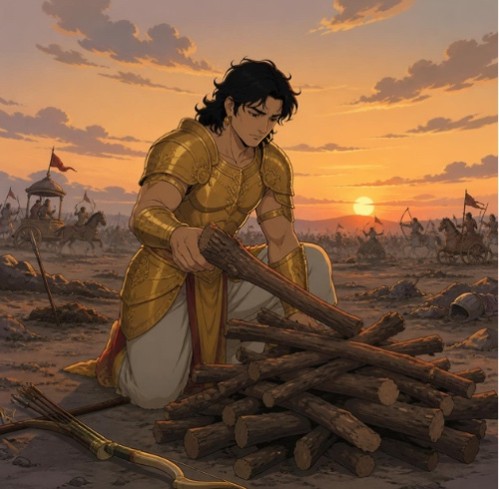
Heartbroken and in tears, Arjuna thought of Abhimanyu. The grief over his son’s death had driven him to take a vow that he would kill Jayadratha by sunset or enter the fire himself. Determined to keep that vow, he lit the fire and prepared to step into the flames.
The entire Kaurava leadership lowered their weapons, assuming the day’s combat was officially over. Krishna maintained silence, pretending to allow Arjuna to fulfill his promise.
The psychological deception worked flawlessly. Jayadratha, who had been trembling in fear deep within the ranks, was overcome with relief. Eager to witness Arjuna’s humiliation and subsequent suicide, Jayadratha emerged from the dense center of the formation. He walked to the front, tilting his head back to gaze up at the darkened sky, openly mocking the Pandavas. Overjoyed, he believed he had avenged the Pandavas for having humiliated him. The Pandavas were distressed by what they saw.
Krishna, who knew all, waited to unfold his divine play. As Arjuna prepared to circumambulate the sacred fire, Krishna instructed Arjuna to raise Gandiva, keep its bow string drawn, and circle the fire while holding a mighty enchanted arrow, a celestial weapon in Arjuna’s possession. Though Arjuna was puzzled by Krishna’s words, as usual he did exactly what Krishna commanded him to do.
In a split second, Krishna recalled the Sudarshana Chakra. The artificial eclipse broke. The brilliant, golden afternoon sunlight burst back onto the battlefield, blinding the celebratory Kauravas. The illusory darkness vanished, and the western sky glowed crimson. Only then did everyone realize that Krishna had obscured the sun with his Sudarshana Chakra.
Krishna pointed a decisive finger at the stunned King of Sindhu, Jayadratha and said to Arjuna, “Behold, Arjuna! The sun is still in the sky. There stands Jayadratha, exposed and within your reach. Take off his head before the true twilight sets in!”
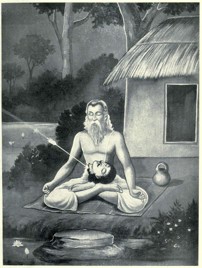
Before the Kauravas could process the illusion or raise their shields, Arjuna’s raised bow did what it had to do. Guided by Krishna’s precise instructions on how to handle the decapitation to avoid a fatal curse from Jayadratha’s father, Arjuna unleashed the celestial arrow.
Severing Jayadratha’s head, the arrow carried the head aloft through the air, and placed it on the lap of Jayadratha’s father, Vridhakshatra, who was deep in penance in the forest. Believing something had disturbed his meditation, Vridhakshatra pushed the head from his lap onto the ground. At once, his own head shattered into a thousand fragments. Thus, the very boon he had given to his son became the cause of his own destruction.
Only Lord Krishna knew the secret of the boon Vridhakshatra had given to his son, Jayadratha. Arjuna survived because Krishna had taken upon himself the responsibility of protecting him.
The Pandavas wept tears of joy. In gratitude, Arjuna embraced Krishna wholeheartedly, again understanding it is all Krishna’s doing that he is achieving these victories. Thus, Arjuna’s vow was fulfilled.
Although the fourteenth day of battle ended at sunset, the fighting did not stop. Enraged by Jayadratha’s death, the Kauravas carried the war into the night, marking it the first terrifying night battle of the war. As the war intensified, the traditions that had been preserved for so long gradually vanished.
Duryodhana was filled with concern. Up until now, he had seen Arjuna as just another warrior, but now he truly understood his strength. Looking back on that battle, he had to rethink his understanding. Still, his heart couldn’t bring himself to give up the Kingdom.
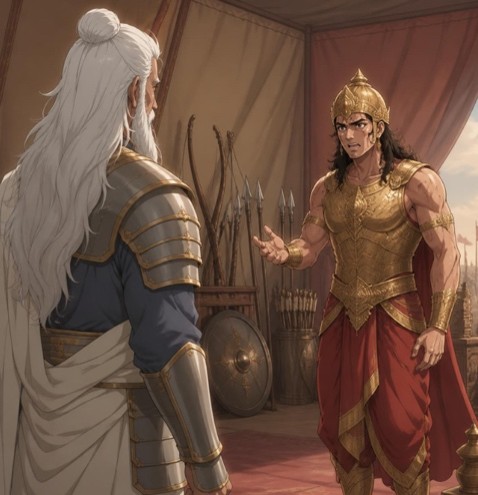
He rushed to Guru Dronacharya’s tent, overwhelmed by exhaustion and grief. Duryodhana said, “In today’s battle, I’ve lost many of my younger brothers, close friends and relatives. Also, the promise I made to Jayadratha was broken. I owe everything to those who sacrificed their lives for me. I’ll kill the Pandavas to make up for that loss. If that seems impossible, I’ll meet a hero’s death at the hands of the Pandavas.” Leaving, he said that one of these two things must happen soon.
Drona was deeply distressed by Duryodhana’s words. Following him out, he reassured Duryodhana saying, “Don’t be distressed. I’ll now demonstrate my full might. I will not remove this armor until your enemies are destroyed. I will destroy the enemy or I will perish in the attempt.” With these words, he hastened towards the battlefield in his chariot, armed with a bow and spear.
Arjuna knew Drona was coming because of the sound of his chariot. Dhrishtadyumna, the commander of the Pandava army, came up with a plan for the night battle. He said that demons are stronger at night, so he gave more important roles to Bhima’s son, Ghatotkacha, and his son, Anchana Parva.
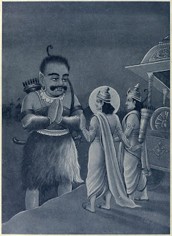
Ghatotkacha was born to a demoness, so he knew how to do illusions and other magical things. He was a special warrior who had half of Bhima’s strength and half of his mother’s strength. He was also waiting to get revenge on the Kaurava forces that had killed his cousin, Abhimanyu, unfairly. He was happy to take on the responsibility and trusted himself completely.
He went to his father, Bhima, to Yudhisthira and to the other Pandava brothers, asking for their blessings. He also went to Krishna for his blessings. As never before, Krishna hugged him tightly that day. Pausing for a moment, Krishna looked at him closely and blessed him, saying, “May your fame last forever.” Filled with new energy and remembering Abhimanyu, Ghatotkacha ran impatiently towards the battlefield.
The fighting that night was far more intense than the day’s events. Dronacharya fought with incredible ferocity, convincing everyone that he was Arjuna’s guru. He relentlessly struck down anyone who dared to challenge him, decimating the Pandava forces.
Dronacharya ordered that Arjuna be guarded and kept away from him, as he was the only person capable of challenging himself. Tragically, Dronacharya also killed the son of Dhrishtadyumna that night. Dhrishtadyumna, overcome with grief over the loss of his son, was just as devastated as Arjuna.
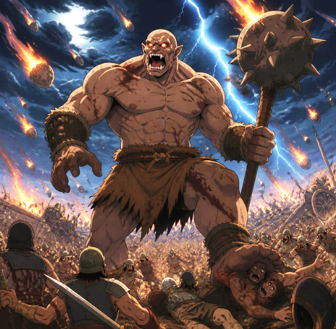
On the other hand, Ghatotkacha fought with great ferocity. Ghatotkacha’s supernatural power multiplied exponentially at night, making him virtually invincible in the dark. He filled the sky with terrifying illusions, raining down boulders, fire, and giant weapons onto the Kauravas. The Kaurava forces witnessed him single-handedly slaughtering thousands of warriors, which frightened them and caused them to retreat.
Ghatotkacha’s son, Anjana Parva, waged a fierce battle against Ashwatthama. After a prolonged battle, Anjana Parva was killed by Ashwatthama. Enraged by the loss of his son, Ghatotkacha waged a fierce battle against Ashwatthama. Finally, losing his balance, Ashwathama fainted and fell. Ghatotkacha moved away from him, leaving him in a daze.
Arjuna contemplated fighting Karna, but Krishna refused. Krishna advised against nighttime battles and suggested fighting Karna during the day. Ghatotkacha was sent to fight in Arjuna’s place.
Ghatotkacha focused all his energy on destroying the Kaurava forces. It seemed as though he alone would annihilate the entire Kaurava army before dawn. Karna fought against Ghatotkacha with great fury but was no match for Ghatotkacha’s supernatural powers.
More to come…
- Bhima throws a dead elephant at Karna. https://www.reddit.com/r/mahabharata/comments/1w46nup/bheema_throws_dead_elephants_at_karna/
- Krishna with Sudarshana Chakra. https://ca.pinterest.com/pin/318911217386442549/
- Arjuna preparing funeral pyre. Image by S.A. Hancherow/Canva
- Vridhakshatra & Jayadratha’s head. https://picryl.com/media/jayadrathas-head-falls-in-his-fathers-lapef9cd1
- Drona & Duryodhana Image by S.A. Hancherow/Canva
- Ghatotkacha, Krishna & Yudhisthira https://indus-meetindus.blogspot.com/2017/03/kurukshetra-war-night-14.html
- Ghatotkacha Image by S.A. Hancherow/Canva