By Nirooshitha Sethuram, Yogaratna
Graphics by Sheralee (Shambhavi) Hancherow
Seventh Day of the War
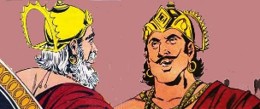
Duryodhana, wounded and demoralized by previous defeats, headed to Bhishma’s tent in the morning. With a tone of worry, he pleaded, “Grandsire, how am I supposed to succeed without your guidance? Every day the battle turns against us. Our lines are collapsing.
“My brothers and fellow warriors are being killed. I feel helpless as I witness this devastation. You, whom I believed would be our savior, seem to do nothing. How can we possibly hope for victory?”
Bhishma spoke, his voice steady as a stream amidst the storm. “Duryodhana, why do you allow despair to seize you? Do you not notice the great warriors fighting at your side? Each one stands prepared to lay down their life for your cause.
“Your army is vast, your soldiers courageous. Having allies like these makes you nearly unbeatable. I’m giving it everything I’ve got. Don’t let yourself be consumed by despair — there’s still hope.”
Duryodhana’s injured spirit found comfort alongside a remedy for his physical wounds. The medicinal treatment not only eased the prince’s pain but rejuvenated both his mind and body. Restored in confidence, Duryodhana went back to the battlefield, resumed command and led once again.
The battle that day occurred across multiple fronts, with Bhishma leading the defense against Arjuna. Drona defeated King Virata of Matsya, forcing him to flee his chariot and join his son Shankha. However, Shankha was killed, deepening Virata’s sorrow after losing two other sons.
At another battlefield site, Shikhandi confronted Ashwatthama. The fight was fierce. Ashwatthama broke Shikhandi’s sword and forced him to retreat to Satyaki’s chariot. Although Shikhandi suffered defeat, he pledged to regain strength and return.
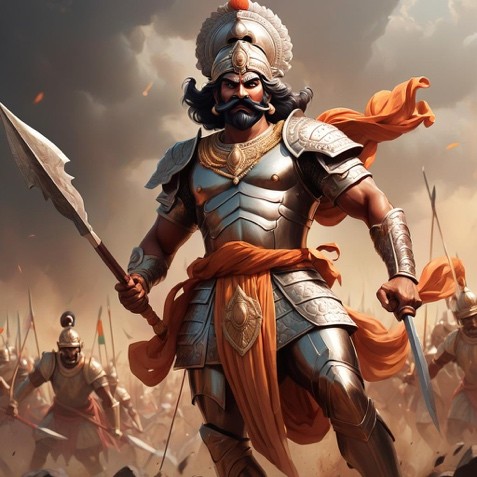
During the confrontation between Satyaki and the demon Alambhasan, Satyaki encountered significant setbacks at first. He ultimately prevailed, forcing Alambhasan to retreat.
Duryodhana personally confronted Dhrishtadyumna, the Pandava general. During the fierce battle, Duryodhana’s horses were killed and his chariot was destroyed. Undeterred, he fought bravely on foot with his sword until Shakuni arrived just in time to rescue him and carry him away in his chariot. Seeing their leader wounded and taken from the battlefield demoralized the Kaurava forces.
Bhima, demonstrating his exceptional strength and determination, launched a relentless assault on the Kaurava warriors. At one point, this compelled Kritavarma to abandon his chariot and withdraw from the battlefield, wounded and humiliated.
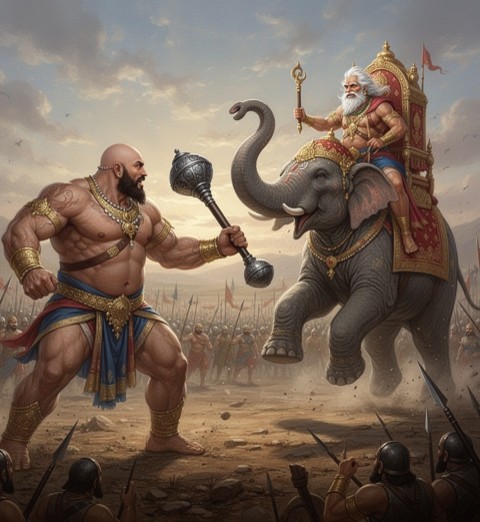
Bhima’s son, Ghatotkacha, confronted the powerful Bhagadatta, renowned for commanding his formidable war elephant. Although Ghatotkacha fought valiantly at first, Bhagadatta’s superior skill and strength ultimately overpowered him. As a result, Ghatotkacha had to retreat, which provided the Kaurava army with a significant morale boost.
Nakula and Sahadev fought together to defeat the seasoned warrior Shalya. Shalya was their maternal uncle. Recognized for his expertise in both archery and warfare, Shalya responded with swift weaponry. During the clash, Sahadeva struck Shalya’s chariot with his spear, while Nakula, through notable bravery, succeeded in neutralizing Shalya’s bow.
Impressed by their combat prowess, Shalya found himself exhausted. He eventually lost consciousness and fell unarmed into his chariot. Upholding the principles of dharma, the brothers Nakula and Sahadeva refrained from harming Shalya further and allowed him to live.
Yudhishthira demonstrated remarkable courage in battle against Shruta, ultimately killing his charioteer and compelling Shruta to retreat. His fierce fighting stunned his warriors. On this day, Yudhishthira’s usual temperament was overtaken by a display of anger.
Yuyutsu fought Kripacharya, the Kauravas’ royal priest, and was injured by him. Abhimanyu, the Pandavas’ young warrior, quickly overcame Duryodhana’s three brothers but let them go, remembering Bhima’s vow and Draupadi’s pledge. The day concluded with Bhishma engaging in combat with Abhimanyu.
Observing the young warrior face such an experienced adversary, all five Pandavas promptly intervened to support him. Nonetheless, despite their collective strength, Bhishma remained resolute, utilizing his profound expertise and skill to keep the Pandava warriors at bay.
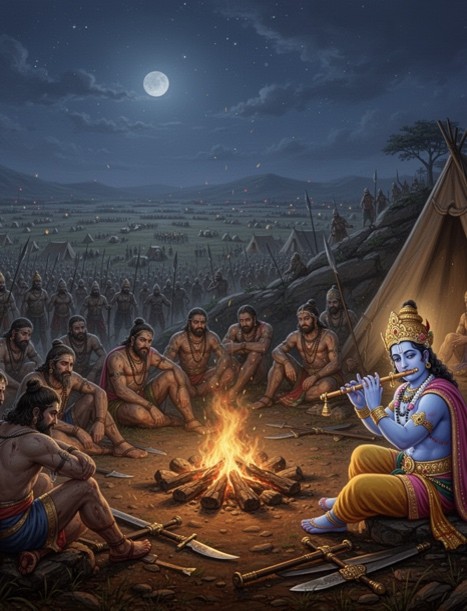
As sunset marked the end of the seventh day of battle, the warriors returned to camp. That night, Krishna’s flute calmed the wounded and grieving, illustrating that even during hardship, compassion and reflection remain possible.
Eighth Day of the War
At dawn, Bhishma organized the army into the tortoise (kurma) formation, a strategic defensive structure intended to effectively resist and counter attacks from every direction.
Noticing this, Yudhishthira instructed Dhrishtadyumna to respond by organizing the troops in a way that could break through the enemy’s defenses. Dhrishtadyumna then arranged the Pandava army into a three-pronged formation. Bhima led one wing, Satyaki another, with Yudhishthira at the center front.
Bhima fought fiercely in the Kaurava ranks, using his mace to kill eight of Dhritarashtra’s sons early in the battle, deeply wounding Duryodhana emotionally. Nevertheless, the Pandavas were not exempt from sorrow.
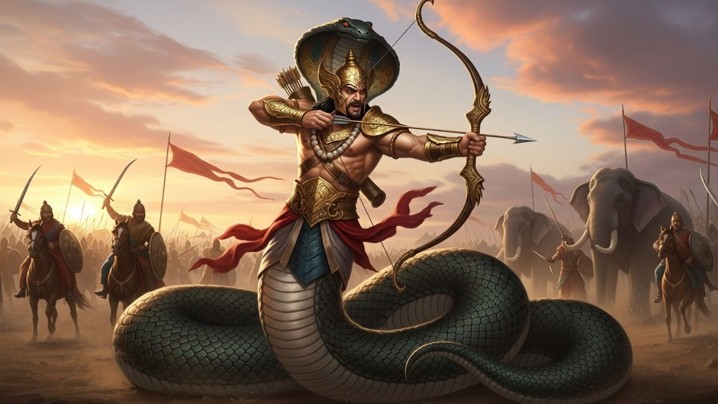
Iravan, Arjuna’s cherished son with the Naga princess Ulupi, entered the battlefield to support his father. He confronted Alambhasan, a rakshasa who loyally served Duryodhana.
Drawing upon his serpent heritage, Iravan fought swiftly, yet Alambhasan’s sheer power eventually proved too much. After a lengthy struggle, Iravan was defeated, leaving the Pandavas enveloped in grief.
When Arjuna heard of Iravan’s death, he was devastated and questioned the purpose of the war. Krishna, seeing Arjuna’s sorrow, told him to focus on his duty as a warrior and use his pain as strength.
Iravan’s death angered Ghatotkacha, Bhima’s rakshasa son, whose war cry intimidated the Kaurava soldiers. He disrupted their formation with his strength and powers, causing chaos. Duryodhana responded by leading an assault against Ghatotkacha himself.
The king of Vanga joined him, bringing armored elephants that offered crucial support and added excitement to the scene. Ghatotkacha threw a massive javelin at Duryodhana, but the Vanga king intervened, sacrificing one of his elephants to protect the Kaurava prince. The elephant’s fall shook the earth and momentarily brought the battle to a halt.
When Duryodhana was at risk, the senior warriors used their experience to strengthen the Kaurava lines. Bhisma led the effort, breaking through the Pandava ranks.
Yudhishthira sent Bhima to aid Ghatotkacha, who was encircled by Kaurava warriors. Ghatotkacha gave out a loud roar. Hearing it, Bhima rushed to help. Together, they defeated the enemy, and by sunset, Bhima had killed sixteen of Duryodhana’s brothers.
As night fell, the Kaurava camp was demoralized and depleted, surrounded by fallen warriors. The Pandavas felt the heavy loss of Iravan, despite Bhima and Ghatotkacha’s successes.
Duryodhana, disheartened by defeat and the relentless Pandava advance, withdrew to his tent, bracing for more conflict ahead.
Ninth Day of the War
Before the battle began, Duryodhana approached Bhishma with harsh words, expressing his frustration over their defeats and provoking the noble elder.
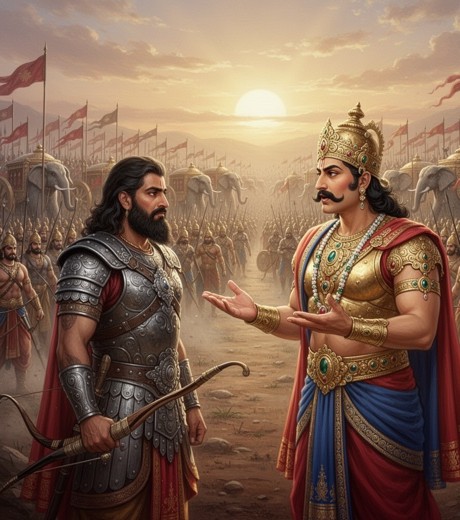
Yet Bhishma remained calm and did not lose his composure. “I am sacrificing my life for you on this battlefield; my arrows are my offering, fulfilling my duty,” he replied. “Why have you allowed despair to cloud your judgment? The difficulties you face now are the consequence of your own actions.
“Nevertheless, I will fight as fiercely as I can against all opponents except Shikhandi or the Pandavas — my heart cannot wield weapons against them. Still, be assured, as long as I endure, I will protect your army.”
Duryodhana sought reassurance and addressed Dushasana, “Brother, let us commit our full efforts to today’s battle. Grandsire is engaged on our behalf with unwavering resolve. He has indicated that he cannot confront Shikhandi alone. Our primary concern should be to prevent Shikhandi from engaging him. As even the strongest can fall if vigilant care is lacking, it is imperative we remain alert.”
On that day Abhimanyu fiercely fought Alambhasan the demon, ultimately forcing him to retreat. Abhimanyu thus proved himself as Arjuna’s son. Meanwhile, an intense conflict was unfolding between Satyaki and Ashwatthama on a separate front. Arjuna was involved in a confrontation with Drona. However, this encounter was brief due to Bhishma’s arrival at the scene.
Bhishma overwhelmed the Pandava forces, scattering them and causing widespread panic as their soldiers fled in confusion. The Pandava brothers attacked Bhishma.
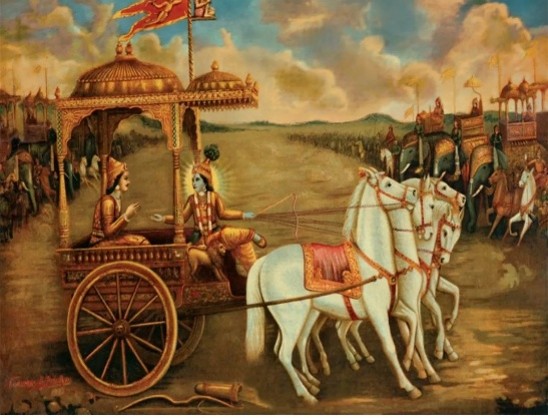
Krishna halted Arjuna’s chariot and firmly reminded him that after all those years of exile, this was the moment to fulfill his duty as a warrior — that his brothers and soldiers depended on him and that he must fight with full strength.
Arjuna, with his head bowed, told Krishna he would rather stay exiled than fight his respected elders but agreed to obey. Reluctantly, he readied himself for battle. As Arjuna’s chariot moved forward, the Pandava soldiers regained their courage. Though hesitant, Arjuna fought back and broke several of his grandsire’s bows. Each time Bhishma calmly picked up another and resumed his relentless attack.
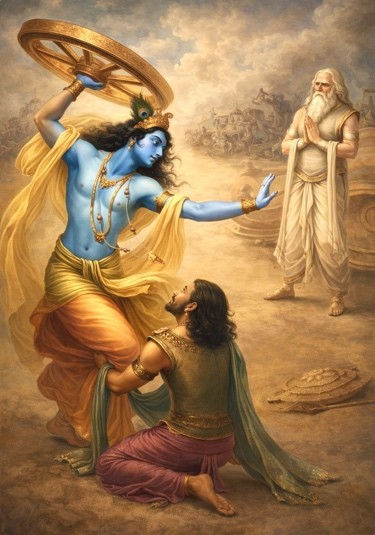
Observing Arjuna’s continued indecision, Krishna’s patience reached its limit. Declaring that the situation was out of hand, he jumped down from the chariot, took up his Sudarshana Chakra (the divine discus) once more, and advanced toward Bhishma with resolute determination.
In response, Bhishma respectfully welcomed Krishna’s arrival with folded hands, prepared to receive him. He expressed his willingness to meet his end at Krishna’s hands without hesitation.
Krishna said to Bhishma that he was fighting for the unjust side and that his unwillingness to give up his life is unreasonably prolonging the war. Krishna also said that the Pandavas, who were his great-grandchildren, were fighting the war reluctantly because he was leading the opposing army.
Bhishma said that he knew his side was unjust, but his vow to safeguard the throne of Hastinapura, forbade him to sacrifice his life. The argument went on for a while, until Arjuna came towards Krishna, pleading with him not to break his vow of remaining unarmed. Arjuna insisted it was his own duty to fight.
Krishna allowed Arjuna to lead him back to the chariot, and the battle resumed with Arjuna fighting harder. Still, despite his efforts, the Pandavas could not prevail.
On the ninth day, as the sun set, the enduring conflicts and challenges of war became apparent. Arjuna’s hesitation, Krishna’s discontent and Bhishma’s formidable presence underscored that the grandsire’s power remained the foremost obstacle to Pandavas success.
It became evident that victory in the war was impossible while Bhishma remained undefeated on the battlefield. The Pandavas approached Krishna to discuss the situation and get some advice from him as to what they can do.
More to come…
- Bhishma & Duryodhana https://mahabharatham.arasan.info/2001/01/Bhishma-Parva-Section-081.html
- Satyaki https://mythlok.com/satyaki/
- Ghatotkacha & Bhagadatta Image by S.A.Hancherow/Canva
- Krishna plays flute for troops Image by S.A.Hancherow/Canva
- Iravan https://shabdyatri.com/english-blog/english-literature/mythology/mahabharata/iravan/#google_vignette
- Dushasana & Duryodhana Image by S.Hancherow/Canva
- Arjuna and Krishna https://tattva.keshavaswami.com/p/good-to-talk-1294854
- Krishna, Arjuna & Bhishma https://ca.pinterest.com/pin/768497123958935523/https://ca.pinterest.com/pin/768497123958935523/