
By Nirooshitha Sethuram, Yogaratna
Graphics by Sheralee (Shambhavi) Hancherow
Chapter 17: Shraddha Traya Vibhaga Yoga (The Yoga of the Three Kinds of Faith)
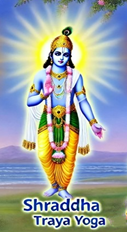
Krishna delves into the nature of faith, and how it shapes the character and destiny of every individual.
While faith is innate to everyone, it is not uniform. It is governed by the three gunas (described in Chapter 14). Depending on which guna predominates, faith expresses itself as uplifting, restless or misguided.
Krishna then turns to the significance of three essential spiritual actions: ceremony (yaj~na), charity (dana), and austerity (tapas). He emphasizes that the true value of any spiritual act lies in the intention, purity and devotion behind it, rather than in the action itself.
He also addresses the importance of the sacred syllable “OM,” which embodies the Divine.
This chapter is an invitation to look at the faith which shapes our choices, to understand its origins and to consciously cultivate the higher qualities within. By aligning faith with wisdom, purity and devotion, every action becomes a step on the path to union with the Divine.
The Dialog
Arjuna asks, “When one disregards scriptural injunctions in their life, but still worships with faith, what is the nature of their devotion?”

Krishna says, “Every being is born with innate faith, which is of three kinds: sattva-goodness, rajas-passion, and tamas-ignorance. The sattvic worship the Gods, the rajasic worship the demons (rakshasas) and the tamasic worship the ghosts/spirits.
The food which is dear to each is of three types, as also ceremonies, austerity and almsgiving.
Food
“Foods which increase life span, health, strength, happiness and satisfaction are dear to sattvic people. These foods are nourishing, juicy, tasty and enjoyable,
“Foods that are too bitter, too sour, salty, pungent, dry and burning are liked by the rajasic. These produce pain, grief and disease. Foods which are stale, tasteless, putrid, rotten and impure are liked by tamasic people.
Ceremonies
“Ceremonies offered without desire for reward and according to scriptural rules, with conviction that this is a duty, are sattvic. But a ceremony performed with expectation of reward or out of pride is rajasic. Ceremonies are tamasic when done without faith, contrary to scriptural rules, without mantras and without offering food or donations.
Austerities
“Worship of the Gods, the wise, the Guru and elders are physical austerity along with purity, uprightness, sexual continence and non-violence.

“Spoken words that cause no distress and are truthful, pleasant and beneficial are austerity of speech, along with the study of the Vedas. Serenity of mind, good-heartedness, silence, self-control and purity of purpose comprise austerity of the mind.
“These three austerities (physical, speech and mind) are sattvic when practiced with faith and desiring no reward. Austerity is rajasic when done to gain honor and respect. The benefits are unstable and temporary. Austerity is tamasic when practiced from confusion, with self-torture or for harming another.

Charity
“If the giver knows it is their duty to give in a fit place and time to a worthy person, the alms are sattvic when given to one who does nothing in return.
Charity is rajasic when given for the sake of recompense, with the expectation of results, or in a grudging mood. Charity is tamasic if given at the wrong place and time, to unworthy persons, with no respect or with contempt.
OM Tat Sat
“From the beginning of creation, OM TAT SAT has been spoken to express Brahman, the Supreme Absolute Truth. From this has come the brahmins (priests), the Vedas and ceremonies. Therefore, those who perform ceremonies, give in charity and do austerities always begin with OM.
“Those who wish to become free from material entanglements utter TAT, as they do not seek the fruits of ceremony, charity and austerity. SAT names Absolute Truth. It is also used to describe an auspicious action, including ceremonies, charity and austerities.
“Whatever ceremony is done, charity given or austerity practiced, but without faith, is called a-sat, meaning perishable. It is useless in this world as well as after death.
Chapter 18: Moksha Sannyasa Yoga (The Yoga of Liberation by Renunciation)
Krishna weaves together the threads of knowledge, devotion and right action, culminating in full surrender to the Divine. True renunciation is not the mere abdication from action but the letting go of dependency on outcomes.
By discerning the forces that drive our actions — clarity, passion and ignorance — we come to act without selfish motives, aligning ourselves with our higher nature. He reveals that each individual’s duty (svadharma) is sacred. Fulfillment comes from embracing one’s own path with sincerity and selfless intent.

The Gita’s final teaching is one of trust and loving surrender. By dedicating all actions to the Supreme One and transcending your ego’s limitations, you discover an unwavering peace and the joy of spiritual freedom.
In letting go of pride, fear and the need for control, your heart opens to Divine presence inside and outside. In this surrender lies the promise of liberation, the realization that your own Self is eternal, untouched by sorrow or change, and ever united with the source of all.
Chapter 18 is a luminous summation of the entirety of the Gita’s wisdom. It is an invitation to integrate knowledge, selfless action and loving surrender — to know yourself as the immortal One, to act without attachment and to yield in trust to the Supreme. In doing so, you transcend all limitations and sorrows, and you realize the ultimate goal: liberation or enlightenment, peace, and the unchanging bliss of the Divine.
The Dialog
Arjuna says, “I desire to understand the truth of full renunciation, tyaga, and of the renounced life, sannyasa.”
Krishna says, “The learned ones say that sannyasa is giving up actions motivated by desire. The wise ones say that giving up the fruits of your actions is tyaga.
“Some say all actions should be abandoned. Others say ceremonies, charity and austerity should never be abandoned. My conviction is that renunciation is of three kinds. Because worship, charity and austerity are purifiers even for the wise, these actions should never be abandoned.
“But these activities should be performed without expectation of result. Prescribed duties should never be renounced. If you abandon them due to delusion, it is tamasic. If you abandon them because they are troublesome or cause physical discomfort, it is rajasic. Such renunciation brings no benefits.
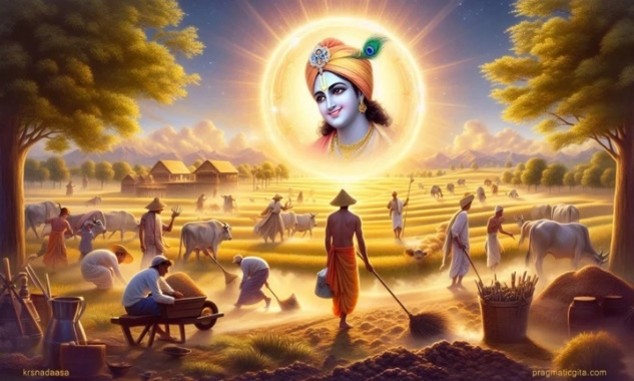
“Renunciation is sattvic when you perform your duty, done without desire for reward. Such a sattvic renouncer neither hates disagreeable work nor is attached to agreeable work. Indeed, it is not possible to give up all actions completely. One who renounces desire for the fruits of action is called a tyagi — a hero, a true renunciant.
“Fruits of action are of three types: painful, pleasant and mixed. After death, these fruits accrue to those who are not renounced, but never to the renounced. There are five causes of action: the body, the doer, the senses, effort and the Divine. These five are the cause with every action performed, whether physical, speech or thought, whether proper or improper.
“Due to impure intellect, one thinks the Self is the doer and is thus unable to see the truth. One who is free from the egoistic notion of being the doer and whose intellect is clear, even if he kills, he will not be the slayer, nor will he incur karmic repercussions.
“Knowledge, the object of knowledge and the knower are the three factors that induce action. The constituents of action are the action itself, the senses and the doer.
“Sankhya describes three kinds of knowledge, actions and doers. Inherent to all beings, sattvic knowledge is seeing the one indestructible reality, intact and whole in all beings. Rajasic knowledge is seeing beings as different and unconnected. Tamasic knowledge is clinging to one thing as if it were the whole, without a reason or based on the truth.
“Sattvic action is in accordance with the scriptures, free from attachment, free from desire and aversion, without depending on reward. Rajasic action is done for the fulfilment of desires or gain, enacted from a sense of ego, and full of stress. Tamasic action is motivated by delusion, with no regard to one’s ability, and disregarding consequences or injury to others.
“The doer who is sattvic is free from worldly attachment and ego, endowed with resolve and enthusiasm, and even-minded in success or failure. The rajasic doer craves the fruits of their actions, is greedy, cruel, impure, motivated by joy and sorrow. The tamasic doer is undisciplined, vulgar, stubborn, deceitful, dishonest, lazy, despondent.
“The three modes apply to intellect and determination. Sattvic intellect understands proper and improper actions, fear and fearlessness, what is binding and what is liberating. Rajasic intellect is confused about righteousness and cannot distinguish between what should be done and should not be done. Tamasic intellect is covered in density, thinking non-duty as duty, seeing untruth as truth.
“Determination or willpower is sattvic when developed through yoga, is unwavering and sustains the mind, prana and the senses. Rajasic willpower holds firmly to duty, pleasure and wealth, clinging to results. Tamasic willpower does not abandon dreaming, fearing, grieving, depression and arrogance.
“Three types of happiness are enjoyed, by which one can attain the end of suffering. Sattvic pleasure seems like poison at the beginning, but is like nectar in the end, coming from the intellect based in Self-knowing. Rajasic pleasure comes from the senses enjoying their objects. It is like nectar in the beginning, but ends up like poison. Tamasic pleasure hides the Self, coming from sleep, laziness and delusion.

“No being is free from these three qualities. Brahmanas, kshatriyas, vaishyas and shudras have their duties distributed according to the qualities of their own nature (not by birth). Brahmins have the qualities of serenity, self-restraint, austerity, purity, compassion, uprightness, knowledge, wisdom and faith in God. Kshatriyas have the qualities of heroism, strength, fortitude, skill with weapons, courage in battle, generosity and leadership. Natural work for the vaishyas includes farming, dairy farming and business. Sudras serve through their work.
“By fulfilling their duties, one attains perfection. Their work is a form of worshipping the One from whom all has come and pervades all. By such work, one easily attains perfection. Doing one’s own duty, even imperfectly, is better than doing another’s duty perfectly. They who do their duties incur no sin. One must not give up the action they were born to do, even if it has defects. The supreme state of freedom from action is attained by having an intellect that is free from clinging and free from desires by renunciation.
“One can also attain the Absolute by transcendental knowledge. For this, one must have a purified intellect, restrain their senses, and abandon attraction and aversion. They relish solitude, eat small quantities, control their speech, body and mind, and are always engaged in meditation. Free from egoism, power, arrogance, desire, anger and selfishness and possessiveness, such a person is full of peace and is fit for union with the Absolute. They become serene, neither grieving nor desiring. Treating all beings equally, becoming Brahman, they attain supreme devotion to Me.
“Only by devotion does one know what and who I truly am. By coming to know Me, one knows the Supreme. Taking refuge in Me, while continuing to perform their actions, one obtains the eternal state by My grace. Dedicating every activity to Me, make Me your only goal. This is the yoga of the intellect (buddhi yoga), keeping your consciousness focused on Me. Thus, by My Grace, you overcome all obstacles.
“If, due to ego, you don’t listen to Me, you will perish. Filled with ego, even if you think ‘I shall not fight,’ your inherent qualities will compel you to do so. Due to delusion, if you decline to act, you will do it anyway, due to your own karma, born of your own nature.
“God dwells in everyone’s heart. According to their karmas, He causes all beings to wander, propelled by their karma and qualities. Whole-heartedly, take refuge in God alone. By grace, you will become established in supreme peace. Thus, I have explained this secret knowledge. Ponder it deeply and do as you choose.

“Hear Me, as you are dear to Me. This is the most secret of all knowledge. Always think of Me, worship Me, bow to Me, and you will certainly come to Me. Abandoning all dharmas, simply take refuge in Me. I will liberate you from all karmic results, do not fear.
“Do not share this knowledge with those who are undisciplined or without devotion. Never tell it to those who do not listen nor to those angry with Me or envious. The devotee who teaches this secret knowledge performs the greatest act of devotion. They will attain Me, without doubt. They are dearest to Me.
“Study of this sacred dialogue is worshipping Me through intelligence. Those who hear this with faith and free from malice will be liberated. Arjuna, have you heard Me with focused mind? Have your delusion and ignorance been destroyed?”
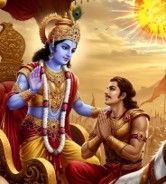
Arjuna replies, “My delusion is destroyed. I have regained knowledge through your Grace. I am free from doubt. I will act according to your word.”
Sanjaya (the narrator) says, “I have heard this wonderful dialogue between Krishna and Arjuna, the noble-hearted one. It is so thrilling that my hair stands on end. Through the grace of Vyasa, I have heard this supreme and most secret yoga directly from Krishna. Recalling it, and the revelation of Krishna’s cosmic form, I rejoice again and again.”
With this the great Bhagavad Gita concludes.
More to come…
- Krishna teaching Shraddha Traya Vibhaga Yoga to Arjuna https://profusp.com/gita-chapter-17/
- The three types of innate faith: Rajas, Sattva & Tamas https://bhaktimarga.ie/chapter-17-of-the-bhagavad-gita/
- Letting go – surrender leads to liberation. https://www.jkyog.org/blog/breaking-attachment-cycle-bhagavad-gita
- Example of rajasic charity. Graphic by S. Hancherow/Canva
- Moksha Sannyasa Yoga https://vedantastudents.com/bhagavad-gita-class-notes-chapter-18-moksa-sannyasa-yoga/#:~:text=Introduction,To%20Access%20more%20other%20text.
- “Sattvic renouncer neither hates disagreeable work nor is attached to agreeable work.”
- Brahmanas, kshatriyas, vaishyas and shudras-fulfilling duties https://pragmaticgita.com/liberation-through-svadharma-18-41to18-48/
- Having devotion and taking refuge in Krishna https://www.radhakrishnatemple.net/blog/how-to-practice-bhagavad-gita-teachings-daily-life/
- Krishna and Arjuna https://in.pinterest.com/pin/409335053649973137/